

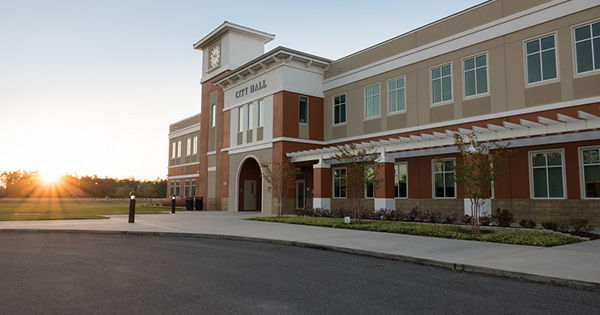
In the longest and most contentious item of the day, the Palm Coast City Council voted 4 to 1 to deny on first reading a rezoning application that would have changed a 10.44-acre parcel at 56 Hard Grove Grade from a light industrial zoning designation, known as IND1, to a heavy industrial zoning designation, known as IND2. The applicant, Hard Rock Materials, sought the rezoning to build a concrete batch plant on the property. Council Member Sullivan was the sole vote in favor. Mayor Norris, Vice Mayor Pontieri, and Council Members Gambaro and Miller all voted no.
The application had already been through a lengthy process. Hard Rock Materials purchased the property in April 2025 after discussions with city economic development staff, who the company says encouraged them to locate in Palm Coast as part of the city’s strategic action plan to attract industrial businesses and reduce the tax burden on residents. The company also invested in six concrete mixer trucks — all visible in the City Hall parking lot on the day of the hearing. The Planning and Development Board had voted 5 to 2 to recommend approval to the council at its February 18th meeting. Attorney Michael Shimento, representing the applicant, cited the city’s own comprehensive plan and strategic action plan, arguing the project directly supported stated goals around industrial development, job creation, and economic diversification.
The application included a series of voluntarily offered restrictive covenants designed to address community concerns. Hard Rock agreed to cap daily truck trips at 200 per day, limit concrete load sizes to 9 cubic yards per truck to keep vehicle weight at or below 68,000 pounds, cap water usage at no more than 25,000 gallons per day averaged over a 7-day period, store no more than 10,000 gallons of diesel fuel on site, and comply with all DEP standards for air quality. The company’s well was required to be positioned as far as possible from two nearby city public water supply wells, based on recommendations from the city’s contracted hydrogeologist.
Opposition was fierce. Business owners in the Hard Grove industrial park packed the chamber and argued the rezoning would fundamentally change the character of a park designed for light industrial uses. Kate Renee Hunter, an employee who works in the park, cited a National Institute for Occupational Safety and Health publication warning that when hydrochloric acid contacts cement dust it can release carbon dioxide and hydrogen chloride gas — both hazardous to inhale. Andy Vargas, owner of Autoasa Palm Coast, argued the traffic study was inadequate because it only examined the intersection of US-1 and Hard Grove Grade and did not account for the full road, lack of alternate egress, or 80,000-pound trucks. ‘Common sense will tell you no company would invest millions of dollars and plan to operate at 20% capacity. Full capacity is 850 trips per day,’ Vargas said — more than four times the capped 200.
The owner of 15 Hard Grove LLC, Dylan Chopra, whose own rezoning application for a concrete batch plant had been denied by the council the previous year, warned of potential legal action. ‘If this rezoning is approved under circumstances materially similar to those under which our application was denied, we believe we would have a strong legal basis to pursue a claim against the city for the substantial damages we would incur,’ Chopra told the council. His company had since pivoted to a luxury car condominium development, and he argued that approving a competing heavy industrial use across the street would directly impair that project. Steve Parish of the Palm Coast Commercial Industrial Center said the businesses in the park collectively employ hundreds of people and followed all the rules when they invested. ‘This community didn’t happen accidentally. It happened because the zoning was designed intentionally,’ he said.
During council discussion, Vice Mayor Pontieri drew the sharpest line. ‘We’re not talking about Hard Rock. We’re talking about Industrial 2. So, I think we’re setting a really dangerous standard,’ she said. ‘Is Industrial 2 compatible in a light industrial park — hard stop — and whether or not the Industrial 2 uses have proper infrastructure for industrial 2 uses consistently, every single day, day in and day out? And I’ve tried to stay quiet about this, but I’m hearing and looking at everything going on and I’m thinking in my head, this is not right the way we’re considering this right now.’ Council Member Gambaro had offered to visit one of Hard Rock’s operating facilities before the second read to better evaluate the dust and operational concerns, but after the vote the question became moot. The motion to approve the rezoning failed 4 to 1, ending the first-read ordinance.
Palm Coast Earns Clean Financial Audit for Fiscal Year 2025 — New Auditing Firm Finds No Issues
The Palm Coast City Council voted unanimously, 5 to 0, to accept the Annual Comprehensive Financial Report, or ACFR, for the fiscal year ending September 30, 2025. The report was presented by Daniel Anderson, audit partner with Malden and Jenkins LLC, the city’s new auditing firm. This was the first year Malden and Jenkins served as Palm Coast’s auditors, taking over from the previous firm. Mayor Norris noted the transition had been seamless. The city had previously pursued a competitive bidding process for audit services, and Malden and Jenkins won the contract.
Anderson told the council the firm issued an ‘unmodified opinion’ — described as the highest form of financial assurance an auditor can provide — meaning the city’s financial statements are presented fairly and free of material misstatement. The audit also included federal and state single audits, required because the city spent approximately $9.5 million in federal awards and just over $10 million in state awards during fiscal year 2025. Anderson reported that neither the federal nor the state single audits produced any findings or recommendations. The so-called ‘yellowbook’ compliance report — which evaluates internal controls — also had no current-year findings to report.
City Finance Director Helena Alves and her team were praised both by the auditor and the council for their cooperation during the process. Anderson noted that all audit requests were handled in a timely manner, there were no disagreements with management over accounting policies, and there were no situations where the auditors discovered an error and required a correction after the fact. One new accounting standard was implemented during the year — a change to how the city accounts for compensated absences — and the audit confirmed it was done correctly.
During public comment, Jeannie Duarte acknowledged the change in auditing firms but argued that the city still needs a forensic or fully external audit — particularly for the utilities division. She said the current process is still an ‘internal audit’ in her view. Vice Mayor Pontieri pushed back directly: ‘I’d just like to note for the record it is an external audit. It’s not an internal audit. Nobody from staff is performing the audit. Someone external is performing the audit, and they have independent access to all the data within our systems.’ The council took the vote immediately after with no further debate.
Two New Wells Come in Under Budget as Council Warns: Florida’s Water Supply Is Not as Plentiful as It Seems
The council voted unanimously, 5 to 0, to approve a construction contract with BPM Constructors Inc. for water treatment plant wellfield expansion — specifically Wells SW-147 and SW-148 — plus approximately 2,000 feet of water main piping. Utilities Director Brian Ramey explained the project involves equipping two already-driven wells with all the infrastructure needed to bring them fully online: concrete pedestals, pumps, piping, and connections to Water Treatment Plant Number 1. The project was originally budgeted at $1.3 million, received seven competitive bids, and came in at approximately $1.1 million — under budget. The project is funded through the city’s capital improvement program.
Mayor Norris used the item as an opportunity to address what he described as a misleading narrative. He noted that just weeks earlier, St. Johns River Water Management District had publicly warned that the Florida Aquifer is facing serious supply challenges — something that contradicts claims made in recent months that the region has plenty of water. ‘I just thought that was of note — that even when people are trying to push a narrative, the facts finally lay out and say, look, we do have issues. We’re surrounded by water in Florida, but that doesn’t mean water is plentiful,’ he said. Council Member Sullivan added that the Florida Aquifer feeds communities south of Palm Coast as well, meaning the district can only allow limited withdrawals no matter how many wells are drilled.
During public comment on the well project, Jeannie Duarte described a four-and-a-half-hour tour she said she took of the city’s water treatment plants in July of the previous year, guided by a city staff member named Pete Rosel. She claimed that during the tour, Rosel closed the door and showed her a large wall map covered in well locations — far more than the 66 she said had been publicly presented. ‘I’m not supposed to show you this,’ she said he told her. She argued the city does not have a capacity or well problem but rather a waste problem, and questioned why new wells were being requested if existing ones already exist. Utilities staff responded by explaining that in hydrology, it is always preferable to have many wells drawing small amounts than few wells drawing large amounts, as it protects the aquifer from overextraction.
The council also voted 5 to 0 to approve a $2.5 million expenditure to replace the deteriorating main administration building at Two Utility Drive — the second-oldest city building still standing, described as more than 50 years old with extensive additions over the years. Staff said the building has suffered from roof leaks, plumbing failures, HVAC issues, pest problems, and interior damage. Repairs over the next several years were estimated at $600,000 to $1 million — and would still not bring the building up to a standard staff considered acceptable. The approved plan calls for demolishing the main administration building and replacing it with prefabricated modular buildings: two leased office trailer units and one purchased triple-wide unit for locker rooms and restrooms, to house approximately 100 utility employees for an estimated three to five years while the permanent Municipal Operations Center, known as the mock, is being constructed.
Vice Mayor Pontieri drove the final direction of the vote, making a motion to purchase the modular buildings outright rather than lease them, at a total cost of $2.5 million. Her reasoning: a five-year lease at $175,000 per year would amount to nearly a million dollars with no equity, while purchasing gives the city ownership and the ability to repurpose the buildings for other uses — including potentially as an animal shelter if needed. Council Member Miller seconded the motion. Jeannie Duarte was the lone public commenter in opposition, calling the request ‘outrageous’ and suggesting staff should apply ‘bubble gum and duct tape’ to the existing building rather than replace it. The council voted 5 to 0 to approve the $2.5 million purchase.
COUNCIL BUSINESS & CLOSING ITEMS
Council Flags Sports League Fairness, Animal Code Review, and Infrastructure Concerns in Closing Session
The consent agenda was approved unanimously, 5 to 0, after a brief discussion on several items. Council Member Sullivan asked for clarification on easement vacations tied to the Municipal Operations Center site, which City Attorney Duffy and Carl Cot explained involve clearing previously proposed road right-of-ways on land that was transferred to the city as part of the mock project. A road right-of-way map was also approved as part of the same package, establishing the alignment for the city’s westward road extension. Mayor Norris said he wants to continue seeing reports on any items approved administratively — particularly those related to plats and replats — noting that water capacity remains a concern as the city grows. The council also discussed a grant application for Waterfront Park improvements through the FIND program, with Vice Mayor Pontieri asking that the city not over-commit to matching funds for items that may not be necessary, such as additional fishing piers.
Vice Mayor Pontieri brought two items forward for council consensus near the end of the meeting. First, she reported on a quarterly liaison meeting with the Flagler Humane Society in which it was discovered that the city’s animal control code is not fully consistent with current state statute. She asked the council to direct staff to bring the full animal control section of the city code back for a workshop. The council agreed by consensus to wait until after July 1st — when any new state legislation related to animal cruelty would take effect — so the workshop can incorporate all current and upcoming changes in one revision. The governor was noted to be in the process of signing new animal cruelty legislation with increased penalties.
Second, Vice Mayor Pontieri raised growing concerns about how the city issues field use permits to sports leagues, specifically regarding fairness between local leagues and out-of-county leagues. She said she has surveyed surrounding counties and believes out-of-county leagues should pay higher permit fees than local ones — which she called standard practice. Council Member Gambaro added that the Indian Trail Sports Complex has long-standing agreements with Little League that allow the organization to claim fields as permitted even when they sit empty, preventing other groups like travel ball teams from using available space. ‘If somebody wants to use a field and it’s sitting empty, I think it’s a problem,’ Gambaro said. The city manager said Parks Director Hurst had already been briefed and has a meeting scheduled with the league the following Tuesday. The council directed the Parks and Recreation Advisory Board to take up permitting fairness and fee schedules as one of its first official tasks.
Council Member Sullivan acknowledged fallen service members during his closing remarks, noting that the KIA count from ongoing operations stands at 13, with approximately 200 injured. He called on the community to keep those families in their prayers. Council Member Gambaro announced a council bracket competition for the NCAA March Madness tournament, with council members each contributing $50 and the winner choosing a charity to receive the pot. The mayor noted the Florida Gators had recently been humbled in the SEC tournament but remain in the top five seeds entering the tournament. The city attorney’s only closing comment was a happy St. Patrick’s Day wish. The meeting was adjourned shortly thereafter, with Mayor Norris remarking it had been a record night.