
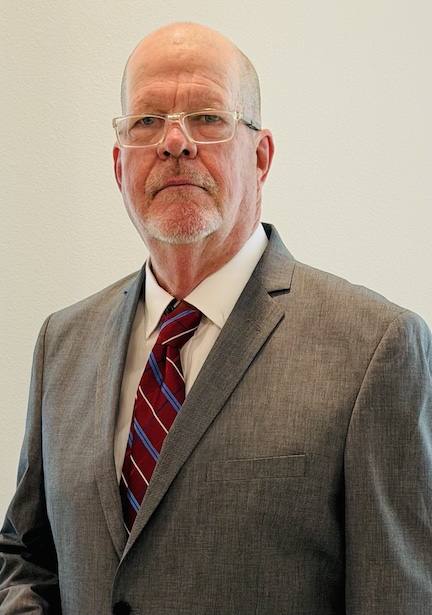
Jimmy Hengy, a candidate for Palm Coast City Council District 2, is bringing a business owner’s perspective to the race, driven largely by concerns over rapid development and what he describes as a city struggling to keep up with its own growth. Henge, who relocated from South Florida about a year ago after searching throughout Northeast Florida for a place to settle down, said it was the beauty and community feel of Palm Coast that won him over, and the fear of losing that character that pushed him into the race.
“I moved in a year ago, almost to the day, got really concerned with all of the building going on,” Hengy said. “That’s not what attracted us here to Palm Coast.” He pointed specifically to the roughly 19,000 lots already approved for construction, a $248 million bond taken out to improve the water system that he says will not be enough to handle existing approved sites, and a proposed expansion of 22,000 additional homes west of US 1 as central concerns. He also raised questions about high-density housing developments with lots as small as 2,500 square feet, saying that while proponents cite affordable housing as the goal, many new developments are already starting at $200,000 to $300,000. “This is more like a bedroom community,” Hengy said. “I’m not against development. I just think it’s the wrong type of development.”
On infrastructure, Hengy said it is the number one issue he hears from residents, with water quality and cost consistently topping the list of complaints. He noted that utility rates are set to increase four percent each October through 2029 and called for a pause on new development until existing infrastructure can catch up. He also pointed to aging water and wastewater treatment facilities originally built in the 1970s and flooding and drainage problems in neighborhoods like the L section, where he lives. “I think that we should pause on the development and let our infrastructure catch up, and then maybe rethink the high-density development into something more spacious and upscale and help protect the value here,” he said.
When asked about road projects happening simultaneously across the city, Hengy acknowledged the improvements but expressed uncertainty about the timing and planning behind running multiple projects at once. He said that without a deeper understanding of how the road and bridge department schedules its work, it would be difficult to say definitively whether the approach was right or wrong, adding that knowledge of the inner workings of each department would be essential before concluding. The same theme of needing firsthand information before making judgments carried through his answer on the DC Blocks development, the proposed cable landing center that has generated significant community debate. Hengy said he does not currently believe the facility is secretly intended to become a data center, and noted that the city council passed a resolution requiring unanimous approval for any expansion. “Before I would ever decide on a data center, I’d want to go and see and talk to the nearby residents and see hands-on,” he said.
On city finances and spending, Hengy raised concerns about what he views as potential inefficiencies in city staffing and salary structures, citing examples of department heads earning $120,000 a year while overseeing only 20 employees, and reported salary comparisons showing some Palm Coast positions paid $40,000 more than equivalent roles in Jacksonville. He said he is not interested in pointing fingers without verifiable information but believes a thorough review of job descriptions, organizational structures, and departmental transparency is necessary. He also expressed support for the proposed homestead exemption ballot measure, not necessarily for the revenue implications but because it would prevent residents from losing their homes over unpaid property tax liens. “If it’s a sales tax, if you don’t want to buy it, you don’t buy it,” he said, noting that visitors would also contribute to that alternative revenue stream.
Among his forward-looking proposals, Hengy said he would like to see commercial development spread more evenly throughout the city rather than concentrated along State Road 100, and he pitched the idea of a business incubator program modeled on his own decades of entrepreneurial experience. With 40 years in business, including a manufacturing company and a retail store, he said such a program could help residents launch service businesses in trades like HVAC, plumbing, electrical, and landscaping, ultimately growing the tax base and reducing reliance on outside employers. “Incubator, you put the egg in, and you warm it until it hatches, until it grows,” he said. He added that he sees potential for eventually attracting light industrial and tech jobs tied to the region’s proximity to the Space Coast. Hengy said his background sets him apart from the other candidates in the race, and that his primary motivation for running is straightforward: “Instead of sitting back and just complaining about it, I figured I’d throw my hat in the ring and see if there’s something I can help do about it.”

In theory, we hired a city manager to address issues of depth and breadth of organizations, as well as pay structure… not the city council’s role… unless they are unhappy with the city manager ‘s performance (which is too soon to say IMO).
Get rid of all the dollar stores and low income housing. People complain about all the crime, but you’re making Palm Coast a “cheap” place to live! Along with “affordable ” housing and shopping, comes all sorts of crime throughout the spectrum from vandalism all the a way to homicide and everything in between. Make Palm Coast Great Again!!
Affordable Housing??? Do you know how much those apartments etc. costs? There are no cheap places to live in here. A one bedroom apartment costs more than my monthly mortgage and I have a house with 4 bedrooms, 2 baths..
Affordable Housing??? Do you know how much those apartments etc. costs? There are no cheap places to live in here. A one bedroom apartment costs more than my monthly mortgage and I have a house with 4 bedrooms, 2 baths..
Sounds very common sense, and a welcome change to current incumbents.
I agree, so far, with his intended proposals, research and cut backs. (If he truly intends to take this approach if in office.) And I agree with Scott Praetz’s comment. It’s disappointing and frustrating to go to the city council meetings, speak up and have the voice of the public be ignored by all but one council member, the mayor, in most cases. The current council, based on their votes, seems intent, in my opinion and despite what the residents voice at the meetings, on approving one large subdivision after another, before infrastructure; ground water management from all the impervious areas being created; utilities and other “growth problems” and the costs thereof are under control and removed from the backs of the residents. You don’t put an addition on a home until the main structure is sound, or until you have the funds to finish it! It breaks my heart to voice this, but I’m very frustrated and concerned with/over the current council and it’s decisions.
We moved here 1984, from Redlands/Homestead Dade county. I was 17, hated the small Flagler County. It grew on me and I loved it by 1989 or so. Loved it for many years. Stopped feeling that way around 5 years ago. It is going down quickly and it’s unstoppable in my opinion. I hope I’m wrong. I’m planning to leave once my family no longer needs me here.