

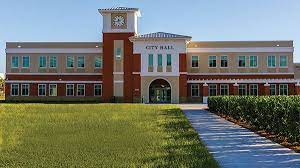
The Palm Coast City Council met Tuesday evening at City Hall for its regular business meeting, working through a wide agenda that included a detailed look at employee health care costs, a heated debate over the future of the State Road 100 Community Redevelopment Agency (CRA), a proposed new approach to regulating data centers, and a range of public concerns from traffic and park lights to animal welfare.
City Weighs On-Site Employee Health Clinic
The meeting opened with a financial presentation from Brian Branham, Vice President of My Health Onsite, a company that has operated an employee health center at Flagler County since 2011. The council had previously requested a five-year cost and savings analysis for the city, alongside a five-year review of Flagler County’s results.
Branham presented county data showing net savings of roughly $546,000 in 2021, $307,000 in 2022, $450,000 in 2023, a significant jump in 2024, and just over $675,000 in 2025 — totaling approximately $27 million in combined savings when all services across the five years are calculated. He noted that 89% of available provider hours were being used by county employees, and that 71% of employees had visited the center three or more times in the past year.
For the city’s projected numbers, Branham modeled a scenario using 32 provider hours per week and an 85% utilization rate, estimating roughly $489,000 in cost avoidance in year one alone, against an operating cost of about $850,000. The return on investment was projected at more than 2-to-1.
Council members pointed out that the city has approximately 600 to 650 employees — about double the county’s workforce — and questioned whether 32 hours per week would be sufficient. Branham acknowledged the capacity could be expanded.
The city’s current health insurance expenses were highlighted during the discussion. Director of Human Resources Renina Fuller noted that health care claims and prescription costs for April alone came in at $790,000 for a single month.
Council members were generally supportive of the concept, noting that combining the proposed clinic with a previously discussed plan to phase out the city’s PPO option would create the greatest overall savings. Several members also emphasized that success would depend heavily on promoting the clinic to employees and driving consistent usage.
The council directed staff to return with cost estimates for setting up a physical facility, since the projections presented do not include capital or lease costs. Lease options reviewed ranged from approximately $59,000 to $67,000 per year. No vote was taken; this was a direction and analysis session only.
Charter Amendments Pass Second Reading Unanimously
City Attorney Marcus Duffy presented the second reading of three proposed city charter amendments, which will go to Palm Coast voters for final approval. No changes had been made since the first read. The council voted unanimously to approve all three.
The amendments address: expanded grounds for removing or suspending an elected official; a revised process for filling council vacancies depending on how much time remains in a term; and an increase in the city’s contracting authority from $15 million to $30 million, with contracts over that threshold requiring voter approval.
During public comment on this item, resident Jeanni Duarte raised questions about the history of changes made to the Palm Coast City Charter since the city’s incorporation in 1999, including questions about whether certain past changes received proper voter approval and how council compensation had changed over the years. Council members responded that none of the currently seated members were in office when the salary changes were made and that the process involved multiple public meetings and ordinances passed by prior councils.
The CRA Debate: Sunset It Now, or See It Through?
The council recessed briefly and reconvened as the State Road 100 Corridor CRA Board to take up a resolution approving a contract with Kimley Horn for a comprehensive review of the CRA. The scope had already been trimmed from $139,988 to $96,770 after earlier council direction to remove items such as expansion and contraction analysis.
The CRA was created in 2004 to promote redevelopment along the State Road 100 corridor. Staff noted that taxable value growth within the CRA has fallen approximately $839 million, or 74%, below the projections in the original 2004 plan. With about eight years remaining before the CRA sunsets in 2034, staff said the study is meant to help the board understand how best to use the remaining projected $24 million in revenues.
Staff also shared that the city is preparing an agreement to sell approximately 8.5 acres of CRA land along State Road 100 for a proposed 36-bed medical rehabilitation hospital — specifically a physical therapy facility for post-acute patients. The project is anticipated to generate about $31 million in capital investment and create roughly 100 full-time jobs at an average annual salary of $75,000.
Mayor Norris questioned the value of the study, arguing that the CRA has underperformed for 22 years and that the roughly $3 million per year flowing into it could be better used in the city’s general fund — particularly for roads and infrastructure. He raised the possibility of sunsetting the CRA now rather than waiting until 2034. “The CRA has been a dog for 22 years,” Norris said. “That dog won’t hunt.”
Other council members pushed back, arguing that the CRA is finally showing momentum — with the Promenade, a miniature golf course, and the proposed medical rehabilitation facility all in progress. They pointed out that sunsetting the CRA would not send all of the money to the city, as a significant share comes from county tax increment funds that would revert to the county.
Vice Mayor Pontieri asked the city attorney whether the council could pass a resolution now to ensure the CRA cannot be extended beyond 2034. City Attorney Duffy noted that an extension would require county approval as well as a council vote under state statute, and that the ordinance creating the CRA already calls for it to sunset.
During public comment, resident Darlene Shelley expressed strong dissatisfaction with the CRA’s track record, citing the subsidization of apartment construction through impact fee credits and the lack of quality restaurants and commercial development in the town center. “We were ripped off,” Shelley said. “We continue to get ripped off.”
The board voted unanimously to approve the Kimley Horn contract and move forward with the study.
Data Centers: Council Moves Toward Stricter Rules
Councilman Miller asked for council consensus to direct staff to update the city’s Land Development Code to more clearly define and regulate data centers and similar facilities.
His proposal would create a tiered system distinguishing between “low impact” and “high impact” facilities based on thresholds such as square footage, power consumption, water usage, and noise generation. High-impact facilities would be placed in a “special exception” category, meaning they could not be approved by right — they would always require a council vote.
Miller and other council members emphasized that the cable landing station already approved in Palm Coast — a fiber optic switching facility of about 30,000 to 35,000 square feet — is not the type of facility that concerns them. The worry is about large-scale AI and hyperscale data centers, which can exceed one million square feet and consume enormous amounts of water and electricity.
Vice Mayor Pontieri asked the council to also consider sending a letter of support to Flagler County for a one-year research period to study the issue while the land development code is being updated. Council members generally supported the research direction, though Mayor Norris expressed a preference for immediate action through the code update rather than a moratorium. The council directed staff to begin defining thresholds for what constitutes a high-impact facility and to return with a proposed code update. City Manager Carl Cote and City Attorney Duffy confirmed they understood the direction.
Consent Agenda: Flagler Beach Fire Support, Road Contract, and Golf Course Budget
The consent agenda passed unanimously, but not before discussion on several items.
Flagler Beach Fire Services: The council approved an interlocal agreement allowing Palm Coast firefighters to assist Flagler Beach, which is experiencing a staffing shortage. Mayor Norris and Councilman Gambaro confirmed the arrangement is fully cost-recovered at a FEMA reimbursement rate and that Palm Coast firefighters will be doing so on overtime, on a volunteer basis. Councilman Gambaro noted that if further assistance is needed beyond what was approved, it would return to the council. “This is being a good teammate,” he said.
Paving Contract: Resident Tony Amaral raised a concern that a paving contract being renewed had a fuel escalation clause written over a year ago, when fuel was cheaper. Staff clarified the contract is one of several available vendors, used only for small-scale projects on an as-needed basis. If pricing is unreasonable, the city would bid the work separately.
Golf Course Budget: Vice Mayor Pontieri noted that an irrigation pump replacement at Palm Harbor Golf Club is budgeted and planned. She asked that going forward, all golf course costs be captured within the golf course’s own budget for clarity.
Track 17: Councilman Sullivan stated for the record that he would not support purchasing entitlements for Track 17 at the current asking price. The council noted that the property’s future — whether economic development, a public use, or something else — has not been decided.
Public Comments: Traffic, Park Lights, and Stormwater Accountability
Several residents used the public comment period to raise issues directly with the council.
Traffic at Belter and SR-100: Resident George Mayo returned to his concern about the development at the intersection of State Road 100 and Belter Boulevard, arguing that a lack of a direct entrance from SR-100 will create serious traffic problems and mirrors a situation that arose at a nearby Starbucks years ago. Councilman Gambaro echoed the concern and asked staff to look into why there is no SR-100 entrance on the south end of the development. City Manager Cote acknowledged the concern and said state law limits what can be required of already-entitled projects, but confirmed staff would follow up.
Council Compensation: Resident Jeani Duarte raised questions about how council compensation has changed since the city’s founding in 1999, citing changes from a $1,200 council stipend to a current compensation package that she described as a 151% increase passed in 2022. Councilman Miller clarified that, to his knowledge, none of the currently seated council members receive a cash equivalent in lieu of health insurance, and that most do not use the city health plan. Mayor Norris stated the salary increases were decided by prior councils through multiple public meetings and ordinances before any current member was seated.
Workforce Housing: Carla Amaral, Vice Chair of the Affordable Housing Advisory Committee, asked the council to require future development amendment applications to include an estimate of the financial value created by the requested changes, so that council and the public can evaluate whether any portion of that value should be directed toward workforce housing. She cited the recent Palm Coast Park amendment as a missed opportunity, estimating that the approved changes may have created approximately $9.8 million in value across 244 homes. Several council members expressed openness to the idea but noted that attaching conditions at the second read of an ordinance is not ideal practice.
Stormwater Accountability: Resident Mr. Davis asked the council to establish formal written policies for investigating complaints that developments have caused adverse stormwater impacts on adjacent properties, including documented reviews, public disclosure of any deviations from standards, and periodic audits. Staff indicated they have already been responding to Davis’s written correspondence and have implemented some of his suggestions.
Water Capacity and Noise: Resident James Durso asked about the city’s long-term water supply given ongoing development and the cable landing station project, and also raised concerns about loud vehicles in his neighborhood. Mayor Norris encouraged him to sign up for ALERTFlagler and follow the county’s Emergency Management Operations Center for storm preparedness. On the noise issue, the Mayor said the sheriff’s office would need to be engaged for enforcement, though he acknowledged it is difficult to enforce given the speed at which loud vehicles pass.
Lacrosse Goals: Resident Dewey Schoenfelder asked the council to have the chained lacrosse goals at Indian Trails unlocked so community members can use them. The council directed staff to follow up.
Park Lights for Recreational Soccer: Resident Adrian Calderon, 26, asked why residents who are not part of a registered sports league cannot access lighted fields for informal soccer games, noting that he regularly organizes groups of 40 to 60 players. City staff explained that field lighting is currently prioritized for permitted youth leagues due to limited field inventory. Vice Mayor Pontieri suggested the city look into designating some open-play nights once additional lighted fields are completed at Indian Trails, and said she would raise it with the city manager. Staff confirmed the issue would be discussed internally.
Animal Rescue Support and Other Council Items
Vice Mayor Pontieri asked for council consensus to have staff explore a contract with SMART — a local animal rescue nonprofit — similar to the city’s existing contract with the Flagler Humane Society. She noted that SMART has been overwhelmed handling multiple large animal cruelty cases in recent months, relying entirely on donations. Council members agreed to direct staff to look into the feasibility. East Coast Animal Hospital was also praised for its support of SMART’s efforts.
Councilman Gambaro reported that the Flagler County Commission has given consensus for staff to draft an ordinance governing Accessory Dwelling Units (ADUs) in an effort to get ahead of anticipated state preemption on the issue. He said it may be worth the city monitoring.
Mayor Norris reminded residents that hurricane season has officially begun and encouraged everyone to sign up for ALERTFlagler and follow Flagler County Emergency Management for updates.
Vice Mayor Pontieri announced a fundraiser for the Family Life Center on June 10 at Red Clover in European Village — a karaoke event with tickets at $10, with raffles and food and drink specials.
The city manager noted that informational rack cards about the cable landing station are available in the City Hall lobby, and that staff has been in contact with several residents who raised concerns during public comment.
This article is based on the official City Council Business Meeting I transcript from June 2, 2026.