

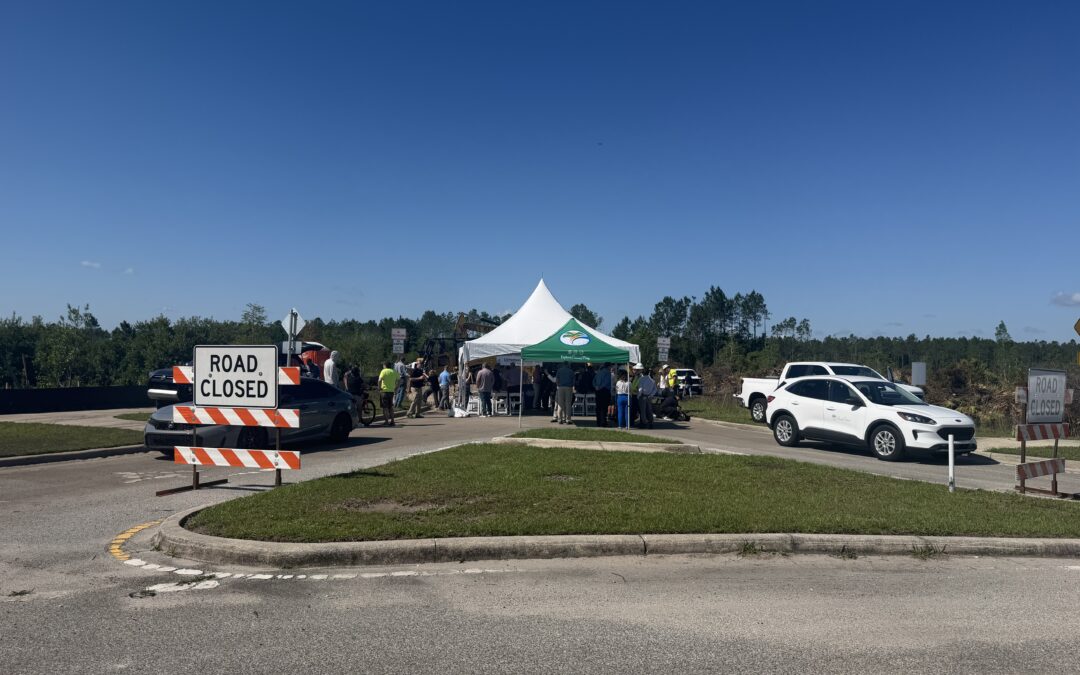
The City of Palm Coast held a groundbreaking ceremony for a new western loop road, marking the start of construction on a project years in the making. The event drew elected officials, city staff, agency partners, and community leaders — but it also produced a rare moment of public disagreement, as Mayor Mike Norris used his time at the podium to openly criticize key aspects of the project he was there to help celebrate.

What the Road Is and Where It Goes
The new multi-lane roadway will extend west of U.S. 1 and include a bridge crossing over the Florida East Coast Railway. That bridge, city officials noted, is designed specifically to improve safety at the rail crossing.
Long-term, the road is planned to connect to State Road 2209, a new state road corridor being developed through western Flagler County. That road will eventually connect to Interstate 4, providing a route to the St. Johns River Bridge area between Volusia and St. Johns Counties.
Councilmember Gambaro, speaking at the event, described the regional significance of that future connection. “You can essentially shoot straight down to right before the St. John’s River Bridge,” he said. “Now, what they’re going to do there, I think, still the Florida Department of Transportation needs to sort that out because that is a major traffic point.”
City Manager Mike McGlothlin framed the project in broader terms, saying it is “designed to improve connectivity, enhance quality of life offerings, and support economic opportunity,” and that it reflects “years of thoughtful planning, coordination, and, most of all, persistence.”

How It Got Funded
The project received more than $120 million in state funding, secured with support from former Florida House Speaker Paul Renner and the Florida Legislature. Officials said the state funding allowed the city to move forward without raising property taxes, utility rates, or impact fees.
However, Palm Coast will still be responsible for contributing a portion of the total cost. Councilmember Gambaro noted that construction costs have been climbing, with the price now running approximately $1.56 million per linear mile of road. “The longer we wait, the more it’s going to cost,” he said, adding that the city may need to return to the state for additional funds as the project progresses.
When asked about earlier community concerns that the developer, not the state, was originally supposed to pay for the road, Gambaro said he could not speak to decisions made before his time on the council, but emphasized gratitude for the funding that was secured.
The Mayor’s Remarks
While other speakers focused on the milestone, Mayor Norris took a notably different tone. He raised concerns about the environmental impact of the road’s path, which he said would cut through wetlands connected to Pringle Branch — a waterway that feeds into Pellicer Creek and eventually the Intracoastal Waterway. He noted that Pringle Branch is part of the Pringle Branch Forever Forest.

“We’re going to cut a path through that swamp,” Norris said. “There’s a reason why those people never annexed in the doughnut hole, as we call it. Because it’s a swamp.”
The mayor said he supports the road’s purpose as a transportation corridor and acknowledged the need for the regional connection to State Road 2209. However, he said he would not support annexing the surrounding land for future development. “We can cut through for the road, for the corridor. But I will not support annexation of that,” he said.
Norris also raised concerns about the city’s financial exposure, questioning how the community could absorb what he described as $330 million in future infrastructure obligations tied to development in the western expansion area alongside the $226 million already committed for the road itself. “I don’t understand how you can go and lobby for money from the state for a road for a total of $226 million and leave the residents of Palm Coast on the hook for $330 million for infrastructure improvements,” he said. “That’s not the way you do business.”
He also made clear his opposition to the broader westward development project, telling those present: “Don’t think I’m going to support your project.”
Closing the Ceremony
Following the mayor’s remarks, Councilman Gambaro stepped to the podium and offered a different closing note. “I’m going to jump in here and end on a positive note,” the speaker said. “Everybody has their own opinions, but this is a time to celebrate a major achievement for our community. We must remain positive.”

The ceremony concluded with the traditional groundbreaking. City officials said residents will begin to see the corridor take shape in the months ahead.
The loop road is one piece of a broader long-term transportation plan intended to strengthen connections between Jacksonville and Orlando as the region continues to grow, according to the City Manager, Mayor Norris, and Councilman Gambaro.