

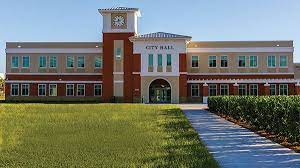
The Palm Coast City Council held its regular business meeting on the evening of Tuesday, March 3, 2026, at City Hall. Three of the five council members were present — Mayor Michael Norris, Vice Mayor Pontier, and Council Member Sullivan. Council Members Gambaro and Miller were absent. The meeting covered a flood awareness proclamation, public comment on charter and spending issues, the approval of meeting minutes, an ordinance on city-owned utility sales, a tabled study of the State Road 100 Community Redevelopment Agency, a vote to renovate the city’s oldest building, a Holland Park turf replacement, sports field lighting, and two matters raised by Vice Mayor Pontier relating to purchasing policy and drinking water protection.
Flood Awareness Week Proclamation
The meeting began with a proclamation declaring March 9 through 15, 2026, as Flood Awareness Week in the City of Palm Coast. City Manager read the proclamation aloud, noting that Palm Coast has experienced significant flooding from extreme rain events and tropical systems, and that the city is a voluntary participant in the National Flood Insurance Program (NFIP). Staff members accepted the proclamation and noted that Palm Coast’s participation in the NFIP’s Community Rating System has earned residents a 30% discount on their flood insurance premiums as a Class 4 community.
Mayor Norris encouraged residents to know their flood zone and take advantage of available insurance. Council members praised the city’s stormwater division, with one member saying, “I think Lynn Stevens and her staff is doing an excellent job. It’s noticeable in the community.” No vote was required for the proclamation.
Public Comment: Charter Review, Sheriff’s Funds, and City Survey
Three members of the public spoke during the opening public comment period. The first speaker, Chantel Pringa, addressed the ongoing charter review process. She challenged the council on its reported opposition to dropping council health benefits — a change proposed by the city’s own Charter Review Committee. “I remind you that you do not have the power to change the charter yourself,” Pringa said. She called on the council to bring charter changes to a public vote rather than deciding internally, adding, “It’s not about protecting your private interests you’ve been elected for, but fulfilling your own promise to serve the city.”
A second speaker, Gary Kunis, suggested a simple fix for filling vacant council seats: rather than appointing someone, the runner-up from the most recent election in the same district should automatically fill the vacant seat. He also criticized what he called an effort by the charter review process to shift power away from the mayor and toward the four council members, saying he believed most cities give the mayor more authority.
A third speaker, Mark Webb, raised a question about the Flagler County Sheriff’s Office. He noted that the city had paid more than $11 million to the Sheriff’s Office above and beyond standard property taxes in the current budget year, and that the sheriff had recently received a $725,000 reimbursement — likely tied to immigration enforcement activities. Webb asked whether the city could recover any portion of those funds on behalf of residents. The city manager said staff would look into whether any process exists for such a request. Council Member Sullivan noted the $725,000 appeared to be related to immigration enforcement.
During the closing public comment period, Webb returned to ask about the city’s ongoing community survey. He noted the survey closes March 15 and asked when results would be available to the public and how the data would feed into upcoming budget discussions. The city manager said he would research that with staff and follow up. Mayor Norris said he had concerns about how representative the survey results would be, noting that only about 1,700 responses were returned in the previous cycle.
Meeting Minutes Approved
The council voted to approve the minutes from the February 17, 2026 business meeting and the February 24, 2026 special workshop. A motion was made and seconded, and the council approved the minutes with a voice vote. All three members present voted in favor. The motion passed.
Ordinance on Sale of City-Owned Utility — Approved Unanimously
The council took up Ordinance 2026-XX on second reading, which governs the process for the potential sale of a city-owned utility. City Manager Marcus confirmed that changes requested at the previous meeting had been made. No formal presentation was given. Council members said they were satisfied with the revisions. One member said the ordinance “has limited probably strength, but I think it’s in this day and age with the changes that we see happening in the country, it makes sense to add that extra step.” No public comment was offered. The council voted unanimously in favor — Vice Mayor Pontier: yes, Council Member Sullivan: yes, Mayor Norris: yes. The ordinance passed 3-0.
SR 100 CRA Study Tabled Unanimously
The council briefly convened as the State Road 100 Corridor Community Redevelopment Agency (CRA) board to consider hiring the consulting firm Kimley Horn to conduct a comprehensive performance review of the CRA at a cost of $124,988. The SR100 CRA was established in 2004 to address blight and stimulate investment along a roughly 1,100-acre corridor from Belair Parkway to Interstate 95. It is funded through Tax Increment Financing (TIF) and is set to sunset in 2034.
Community Development Director John presented data showing the CRA is significantly behind its original projections. The CRA was projected to generate $71.2 million in TIF revenue by this point; it has generated just $19.76 million — roughly 72% below target. The annual TIF collection was projected at a minimum of $7.3 million per year; the city is currently collecting $1.97 million annually. About 47% of the CRA’s developable land remains unbuilt.
Vice Mayor Pontier opposed moving forward with the study at this time, saying it was counterproductive to spend six figures on a financially underperforming CRA without first workshopping the issue with council and reaching out to property owners within the CRA boundary. “I don’t see the value with this price tag,” she said. “I think we probably need to workshop this.” She also argued that the CRA’s underperformance may simply mirror broader development trends across Palm Coast and may not require an outside expert to explain.
Mayor Norris agreed to schedule a workshop, and the director confirmed that CRA property owners had not yet been contacted about the study. A motion was made to table the item. No public comment was offered. The council voted unanimously to table — Vice Mayor Pontier: yes, Council Member Sullivan: yes, Mayor Norris: yes. The motion to table passed 3-0. The director was asked to reach out to property owners before the workshop.
Fire Station 22 Renovation Design Approved Unanimously
After reconvening as the city council, members voted on a resolution approving the schematic design phase and advancing to the construction document phase for the renovation of the city’s oldest building, the former Fire Station 22. The council approved $226,600 in design services fees to be paid to Forefront Architecture and Engineering. The renovation costs are currently being covered by fire impact fees.
City architect Eric Jibo and Parks and Recreation Director James Hurst presented the final schematic design, which was developed through a series of stakeholder meetings with community organizations, fire services staff, and parks and recreation employees. The design includes a 200-square-foot two-story lobby, a 1,150-square-foot exhibition space, a catering kitchen, a second-floor art studio, office space, a multi-purpose workroom, and a patio for outdoor events. The plan also calls for restoring several original architectural features of the building, including what one council member called the “bell tower.” A concrete pad will be installed to display the city’s historic fire truck.
Vice Mayor Pontier, who said she fought to preserve the building when it was previously slated to become a parking lot, praised the design and called on staff to aggressively pursue grant funding. Two grant opportunities were noted: a Florida Cultural Arts grant and a Lowe’s Community Impact grant, which staff said was already packaged and ready to submit. Pontier said, “I don’t look at this as a pet project, but based on some of the needs of the city, things like this can tend to drop off if funding gets tight.”
Peter Johnson of the Palm Coast Historical Society spoke during public comment, saying the society’s board had officially approved a model in which the city retains ownership of the building and can rent out the space for cost recovery, while the Historical Society furnishes it and provides volunteer docents. Council Member Sullivan said the facility should be focused primarily on fire department and Palm Coast history. The city manager confirmed that a memorandum of understanding between the city and the Historical Society would come back before the council for approval.
No additional public comment was offered. The council voted unanimously in favor — Vice Mayor Pontier: yes, Council Member Sullivan: yes, Mayor Norris: yes. The resolution passed 3-0.
Holland Park Synthetic Turf Replacement Approved Unanimously
The council approved a resolution authorizing $256,000 to replace the synthetic turf at Holland Park. The turf, which is approximately 10 years old, has reached the end of its useful life. Staff said patching and repairs are no longer effective because the replacement material does not match in color or texture. The work covers Phase 1 of the park — the area surrounding the sugar mill and the zip line. The contract is with Forever Lawn out of Claremont, Florida. Tree removal needed for the project will be handled in-house. Staff said closures to the park will be kept to a minimum and work will be phased to avoid disrupting scheduled events.
Vice Mayor Pontier initially expressed concern about the funding source but was reassured by city staff that it comes from the capital projects fund — not the parks and recreation operating budget — and that emergency funds are available in the capital projects fund if needed. The synthetic turf has an expected lifespan of approximately 10 years. No public comment was offered. The council voted unanimously in favor — Vice Mayor Pontier: yes, Council Member Sullivan: yes, Mayor Norris: yes. The resolution passed 3-0.
Indian Trails Sports Complex Lighting: Consensus to Pursue Grant
Mayor Norris informed the council that the city of Flagler Beach recently returned unused grant money to the Tourist Development Council (TDC), money that had originally been awarded for the Flagler Beach boardwalk project. The mayor said he immediately asked the TDC to consider redirecting those funds toward installing lights on the unlit fields at Indian Trails Sports Complex, noting that teams currently cannot practice or play games at night.
The total estimated cost of the lighting project is approximately $650,000 to $750,000, including electrical connections. The TDC grant would cover 50% of the cost on a matching basis, leaving the city responsible for the remaining half. Staff confirmed that the city’s portion would be split between the capital projects fund (46.71%) and impact fees, with a budget amendment to be processed for the current fiscal year.
The council reached consensus to support the grant application and authorize the matching funds if the grant is awarded. An official vote on the grant is expected at the next quarterly TDC meeting. Staff said the lights could potentially be installed by the end of summer if the board approves. No formal roll call vote was taken on this item; the council acted by consensus.
Local Purchasing Preference and Potable Water Reuse: Consensus Reached
Vice Mayor Pontier raised two additional items under council matters. First, she asked for consensus to include a review of the city’s local purchasing preference policy as part of the upcoming procurement ordinance. She said the city currently has a local preference policy but that it contains too much discretionary room, and she wants a clearer standard that prioritizes local and county businesses when bidding for city contracts. The council reached consensus to include this review in the procurement ordinance presentation.
Second, Pontier asked for consensus to have the city’s legal staff draft an ordinance that would prohibit the use of potable reuse water in Palm Coast’s drinking water supply. Potable reuse is the process of taking treated wastewater from sewage systems, running it through advanced purification processes, and blending it into the drinking water supply or injecting it into aquifers. Pontier noted that the state of Florida currently permits this practice and that pilot programs are already underway in Altamonte Springs, Clearwater, and Polk County, as well as in California and Texas.
“I never want to see our city engaging in that. I don’t care how many issues we have with water. I think we need to figure it out,” Pontier said. “I also think that it sends a message to our state legislature to perhaps stop tying our hands with regards to the development that we can control in our own city.”
Mayor Norris said he agreed with the concern but wanted the city’s utility director to present more technical background before moving forward with an ordinance. The council reached consensus to hold a workshop on the topic first, with a presentation from utility staff on how potable reuse works and how it could potentially be regulated. City Manager Marcus confirmed he would work with staff to schedule the workshop.
Other Notes
Council Member Sullivan noted that he had visited the Flagler County Supervisor of Elections office earlier that day to observe the start of the Flagler Beach municipal election and that 185 mail-in ballots had already been received. He said the election’s timing was relevant to discussions about the charter review, suggesting that if the proposed changes were in effect, his own seat might have been on the ballot that day. Mayor Norris closed the meeting by wishing the state of Florida a happy birthday, noting that March 3 is Florida’s statehood anniversary.
This article is based on the official transcript of the Palm Coast City Council Business Meeting held March 3, 2026. More information about the City of Palm Coast can be found at www.palmcoastgov.com. Information about the National Flood Insurance Program is available at www.fema.gov/flood-insurance.

Yes, there is becoming more of a desperate need for the presets of patrolling of the main canals. More people are moving and are thinking there is no limits on how fast they can drive! When you have boats and jet skies doing one after the other it produces lots of wakes almost like you are on the Matanza or the Ocean. Guys building a sea wall across from me had to get someone to set in boat to get people to slow down so they could work. It is getting dangerously and ridiculous on the canals lately. We pay enough in extra taxes to live on main cancels. I know the sheriff’s office get a decent amount from taxes. So do something!! Before someone gets hurt or kill because people are ignorant or don’t know the Laws¡!