

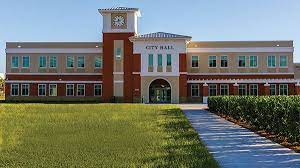
The Palm Coast City Council held its regular business meeting on Tuesday, April 7, 2026, at the John Netts Community Wing. Mayor Michael Norris presided, with Vice Mayor Pontieri, Councilmember Gambaro, Councilmember Miller, and Councilmember Sullivan all present. The meeting opened with four proclamations, moved through several major votes on infrastructure and personnel matters, and closed with a wide-ranging discussion about the city’s upcoming budget cycle and growing financial pressures.
Proclamations
Dispatchers Honored — and a Bigger Fight Mentioned
The meeting began with a proclamation designating the week of April 12–18, 2026, as National Public Safety Telecommunicators Week. Emergency Communications Director Christina Mortimer and newly promoted Emergency Communications Manager Janice Kakavalli accepted the recognition on behalf of the county’s 27 dispatchers, who handled just over 50,000 emergency 911 calls and just under 90,000 non-emergency calls in Flagler County last year.
Mortimer highlighted a recent example of a dispatcher’s life-saving work. “Samantha was able to help those parents that called us just recently,” she said, referring to a dispatcher who guided panicked parents through CPR instructions for a three-month-old infant.
Council members used the moment to raise a broader issue: dispatchers are not officially classified as first responders under state law, which has potential consequences. Councilmember Miller pointed out that ongoing state discussions about reducing ad valorem property tax revenue include protections for police and fire — but not dispatchers, since they lack that designation. “There’s potential that they could be defunded,” he said.
Councilmember Gambaro added that State Representative Danny Alvarez, who chairs the Criminal Justice Subcommittee, has indicated the fight for dispatcher recognition is not over. “Look for him to continue, and all of us here to continue to fight for this because we believe it’s the right thing to do,” Gambaro said.
Water Conservation Month
The council proclaimed April 2026 as Water Conservation Month in Palm Coast. Utility Department representatives accepted the recognition and urged residents to fix household leaks, use water-efficient fixtures, and be mindful of lawn irrigation — especially since most homes in Palm Coast are built on slabs with pipes running underground. Council members noted that an irrigation meter can be installed for a small fee to help lower wastewater charges on utility bills.
Parkinson’s Awareness Month
The council proclaimed April 2026 as Parkinson’s Awareness Month. Representatives from the local Parkinson’s community — which has grown from five people to about 50 monthly participants in four years — accepted the recognition and used the podium to call for more than just awareness. They noted that Palm Coast has only two neurologists, with a waiting list of over nine months, and no movement disorder specialists. “Exercise is not optional for people with Parkinson’s disease,” one speaker said. “It is actually their medicine. It is the only thing proven that will slow the progression down.”
A council member said she was already drafting a message to Advent Health’s government relations manager to explore bringing more resources to the area.
Fair Housing Month
The council proclaimed April 2026 as Fair Housing Month, marking the 58th anniversary of the federal Fair Housing Act. Organizers announced a community Housing Fair on Saturday, April 11 from 10 a.m. to 2 p.m. at the Palm Coast Community Center, featuring free access to attorneys, credit counseling, credit reporting, and public discussions on affordable housing. The fair is open to all residents, not just those looking to buy or rent a home. Councilmember Gambaro and County Commissioner Kim Carney are scheduled to host a community conversation at noon during the event.
25-Year ICMA Recognition
Before the formal business meeting began, the city received a certificate of recognition from the Florida City and County Management Association (FCCMA), celebrating Palm Coast’s 25th year as an ICMA-recognized council-manager city. The award was presented by Dick Kelton — the city’s very first city manager — who noted that ICMA was founded in 1908 and now has over 13,000 members. The council took a moment to also recognize the city’s first elected council member, Bill Venney.
Public Comment
Several residents addressed the council during the public comment period.
A resident named Mark Stancel raised concerns about unequal code enforcement, saying a neighbor was cited for an uncovered air conditioning unit while similar violations on the same street went unaddressed. “Citizens don’t feel like the city is equal to everybody,” he said.
A resident identified as Ms. Duarte called on the council to update the city’s website with boil water notices from January 2026 and to correct meeting minutes from the March 17 meeting, claiming her rights were violated during that session. She also asked for more transparency about how the city’s water programs connect to each other. The mayor clarified the city’s policy on boil water notices — they are targeted by address and street, not broadcast citywide — and said her rights were not violated at the March meeting.
Another resident complained about unfinished road projects in the city, flooding on Rimfire Road, and aggressive e-bike riders on sidewalks. A resident named Jeremy Davis raised concerns about how elevated construction on neighboring properties may be redirecting stormwater onto lower-lying yards, and called for more transparency in how grading and drainage decisions are reviewed. One resident complained about the city’s ordinance allowing commercial vehicles in residential driveways, saying it was causing employees to park on neighborhood grass. The mayor said staff had been asked to review whether the ordinance is creating unintended problems. Another resident raised the issue of dog licensing fees increasing from $5 to $25, and questioned where the money goes. Councilmember Norris clarified that the fee had not been updated since the city’s incorporation and now goes toward animal control officer costs, not SMART or the Humane Society.
A resident named Dennis McDonald questioned the history and cost of deputy city manager and chief of staff positions at City Hall, suggesting those roles had expanded significantly in recent years and cost taxpayers significantly. A resident named Gary Cunha raised concerns about road conditions, canal maintenance, sewer caps leaking into the storm system, and builder-friendly decisions he felt came at the expense of regular residents.
Minutes Approval
Vote: Unanimously approved. The council voted 5–0 to approve the minutes from the March 17, 2026, business meeting with no changes.
Town Center Boulevard Road Improvements — Design Contract Approved
City Traffic Engineer Sean Costello presented a proposal to address growing traffic congestion on Town Center Boulevard, particularly around Imagine School during drop-off and pick-up times and at the intersection of Royal Palms Parkway and Town Center Boulevard.
The proposed long-term solution is to widen Town Center Boulevard from two to four lanes between Central Avenue and Royal Palms Parkway, add turn lanes at key intersections, and install a new roundabout at Town Center and Royal Palms. Two existing roundabouts — at Town Center/Central Avenue and at Central Avenue/Landing — would also be modernized with updated striping, signage, and geometry improvements.
The design contract with RS&H was presented at a total cost of $675,000, funded through the Town Center Community Redevelopment Agency (CRA) — meaning the cost is borne by tax revenue generated within Town Center, not the general public. Short-term fixes — including installing six flashing stop signs, new warning signs, updated crosswalks, and refreshed striping at the Royal Palms/Town Center intersection — will be handled in-house at a cost of just under $15,000, with an estimated 8–12 week timeline.
Data presented showed that drivers waiting to turn left from Royal Palms onto Town Center are currently experiencing average delays of up to 300 seconds during peak hours. The stop sign improvements are expected to significantly reduce that wait.
Council members raised questions about the use of CRA funds versus impact fees, and whether the city was investing those dollars in the most effective way for Town Center’s economic development. One member asked staff to coordinate with the city’s economic development director to ensure road and CRA funds are being used as creatively and efficiently as possible.
Vote: Unanimously approved, 5–0.
Wastewater Treatment Plant Electrical Upgrades — $6.4 Million Contract Amendment Approved
The council approved a $6.4 million Guaranteed Maximum Price (GMP) contract amendment for electrical upgrades at Wastewater Treatment Plant No. 1. The work involves replacing aging electrical equipment — including a new 1,000-kilowatt generator, new switch panels, and control systems — dating back to upgrades made in 1994 and 2006. The project is expected to take 16 months to complete.
The Utility Director explained that this is the first in a series of contract phases, with a $1.2 million site work contract to follow, and a larger GMP3 contract — estimated at over $150 million — coming later this summer as part of a major expansion of the plant’s capacity. All work is being funded through a bond issued the same day as the meeting. Finance Director Helena Alves reported the bond was “fully subscribed at over 6.8 times” and priced at an all-in interest rate of 4.45%, nearly matching the January projection of 4.44% — a result she described as a success given current market conditions.
Vote: Unanimously approved, 5–0.
Compensation and Benefits Survey — Tabled
A $54,500 contract with Evergreen Solutions LLC to conduct a comprehensive city compensation and benefits survey was pulled from the consent agenda at Mayor Norris’s request and sent to a separate vote.
The mayor questioned why the city was paying an outside firm for a study he believed could be handled internally by the city’s HR department, which he said employs graduate-level professionals. “Why are we paying an outside firm the equivalent of someone’s gross annual salary to do a study that we should be capable of doing in-house?” he said.
HR Director Lisa Lynch explained that the contract was the result of a competitive bidding process with seven firms and was the second-lowest bid. She acknowledged that some cities — including DeLand and Largo — are conducting similar surveys internally, while others like New Smyrna Beach and Edgewater use Evergreen. One alternative example noted was New Smyrna Beach Utilities, which conducted its own survey using salary.com for $99.
Councilmember Gambaro and other members expressed concern about a potential conflict of interest if HR evaluated its own department’s salaries, while also acknowledging that the cost could be scaled back. Interim Deputy City Manager Kyle Berryhill noted that doing the work in-house is “not free” and that staff had already invested significant time in the bidding process.
The council voted first to approve the remainder of the consent agenda — 5–0, unanimously — and then separately voted to table the compensation survey item to the next business meeting. The council directed staff to return with an estimate of the staff hours it would take to do the study internally, a comparison of what comparable cities paid for similar studies, and the meeting record where the council originally authorized the bid process.
Vote to table: Unanimously approved, 5–0.
Consent Agenda — Remainder Approved
The rest of the consent agenda, which included a hurricane debris removal contract renewal that Vice Mayor Pontieri praised for having strengthened enforcement terms requiring haulers to retrieve debris within a set timeframe, was approved without further discussion.
Vote: Unanimously approved, 5–0.
City Council Discussion: Budget, CRA, and Staffing
After formal votes concluded, council members engaged in an extended conversation about the city’s upcoming Strategic Action Plan (SAP) process and budget season.
Mayor Norris raised the issue of Palm Coast’s fiscal position relative to a spending growth formula used by the state’s Chief Financial Officer, which compares city budgets to a baseline adjusted for population growth and inflation. Finance Director Alves confirmed that under that formula, the city’s general fund budget is within 5% of the calculated target — approximately $3.3 million over — and that ad valorem (property tax) revenue has grown from $26 million in 2019 to $67 million currently, while the millage rate has dropped from 4.689 to 4.0893, the lowest in the area.
Norris said that despite the favorable rate comparison, he would like the city to cut ad valorem-funded spending by $8 to $10 million. He also suggested the council consider selling the Southern Recreation Center, which he said costs approximately $850,000 per year to operate, and reconsider a proposed employee health clinic that he said would add roughly $1 million to the budget. He also revisited a proposal from last year to shift new employees to a health savings plan, which he said could save $2 million annually and which he believes was passed over too quickly.
Councilmember Miller noted that the city had transferred $2.5 million into the impact fee fund to cover two fire stations because impact fee revenue was not keeping pace with growth — a situation he said has since been corrected, though the city is now being sued by the Home Builders Association over revised impact fee rates. “We are talking about cuts that detrimentally affect our quality of life, and at the same time being sued because we are trying to allow development to pay for itself,” Miller said.
Several council members acknowledged the state’s proposed changes to property tax policy through Senate Bill 180 — though they expressed doubt it would pass this legislative session — and said they want the first budget meetings to include an analysis of what the city’s reserves could absorb if state funding were reduced.
On the CRA, Councilmember Gambaro raised concerns that the Town Center CRA, which sunsets in 2034, has historically underperformed and that the council should prioritize setting goals for it as the governing board before the deadline passes. He called for a focused discussion on whether to extend the CRA’s boundaries, define the types of businesses the city wants to attract, and use the CRA as a more active economic development tool. The council agreed to hold a more in-depth discussion on the topic when the CRA comes before the board at its April 14 meeting.
City Manager Marcus Fortner thanked interim Deputy City Manager Kyle Berryhill for stepping into the role while the position is posted — expected to remain open for about a month — and noted that Chief Clark has stepped in to temporarily fill Berryhill’s previous position.
Fiber line cuts: Councilmember Miller asked for consensus to have the city attorney research existing ordinances around dig permits and whether the city can create fines or penalties for contractors who cut utility or fiber lines without calling for a survey first. The city attorney confirmed that the matter has been under review for several months and that there are limits on what the city can do, but that staff is working on a better process. The council gave its consensus to continue that work.
Consent agenda placement: Vice Mayor Pontieri suggested moving the consent agenda to the beginning of business meetings so that staff members who only have consent items are not waiting through hours of discussion. The council reached consensus to adopt that change, with the city manager noting he would update the city’s meeting policy accordingly. No formal vote was required.
NCAA bracket: In a lighter moment, Councilmember Sullivan was announced as the winner of the council’s March Madness bracket competition. Each council member will donate $50 to the charity of Sullivan’s choice — the Society of St. Vincent de Paul, which is co-located with Flagler Cares. A small trophy will be presented at the next meeting.
The meeting was adjourned following the close of the council discussion.
Coverage of the City of Palm Coast is available at www.palmcoastgov.com. The Housing Fair referenced in this article takes place on April 11, 2026, at the Palm Coast Community Center from 10 a.m. to 2 p.m. For Parkinson’s resources, contact the local group at 386-503-2239.