

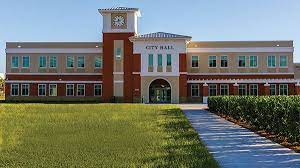
Palm Coast’s City Council workshop on Tuesday opened with a round of pointed public comments touching on everything from water treatment transparency to an emotional defense of Mayor Mike Norris. The workshop drew several regulars to the podium before the council shifted into its lengthy agenda of policy presentations.
Resident Jeannie Duarte opened the session by questioning a water treatment pilot program currently operating at the city’s water plant, saying it had never been put to a public vote and lacked full public disclosure. She also called on the council to table all proposed charter amendments until the proper review cycle of 2028, arguing the city charter itself requires a review every 10 years from its 2018 reorganization. Duarte also raised the question of an appointed council seat that she said was never placed on the November 2024 ballot. “The charter belongs to the voters of Palm Coast, and it should be followed exactly as written,” she said.
Resident Mr. Stone took a sharply different tone, delivering an emotional defense of Mayor Norris against what he called “nasty messages” circulating in the community. “This man has two awards for military bravery. And the way you treat him? It’s terrible. And it affects his family,” Stone told the chamber. He called for the personal attacks to stop and said Mayor Norris would win reelection if a vote were held the next day. Stone also suggested someone in the city’s orbit had shared private information with a political opponent, which he called a possible state violation.
Resident Tony Amaral followed up with a string of budget and spending concerns from the previous meeting, questioning whether the city was spending wisely on the Fire Station 22 design and the SR-100 Community Redevelopment Area study. He noted that the funding source for the fire station project had been publicly misidentified, and the city manager later clarified that it is a split between Park Impact Fees and the Capital Projects Fund, with the construction already included in the five-year Capital Improvement Plan. Amaral also asked whether it made sense to spend $250,000 on architectural plans for a building with no confirmed construction funding in the near term.
Council Member Pontieri later addressed Duarte’s water concerns directly, clarifying on the record that the current pilot programs at the water treatment plant are not related to wastewater reuse or “toilet-to-tap” processes. She said the studies are evaluating advanced water treatment technologies — including ozone, granular activated carbon, and pelletized softening — to prepare for future regulatory requirements. She also praised the Palm Coast Safe Haven Baby Box at Fire Station 25 in the wake of the recent newborn death in the city, urging the community to spread awareness of the resource.
The Palm Coast City Council workshopped a major update to its procurement policy Tuesday, with staff proposing to raise the dollar thresholds that trigger competitive bidding requirements for the first time since 2021. The update is aimed at reducing administrative bottlenecks caused by inflation driving routine purchases above outdated spending limits. The ordinance is scheduled for a first read on April 7, 2026, and a second read on April 14.
Director of Public Works Matt Mansell walked the council through real-world examples of how current thresholds slow operations. Fleet maintenance alone processes 75 invoices per week — sometimes over 100 — totaling four to five thousand transactions per year. He said labor rates for skilled mechanics have risen from about $100 per hour in 2020 to roughly $175 per hour now, with specialized repairs reaching $200 to $300 per hour. A simple fire department van repair that exceeds the current $1,499 threshold triggers vendor registration, purchase orders, and competitive quote requirements — adding three to five days to what should be a quick fix. Mansell showed the council specific examples: fire apparatus headlights available online for $239 versus $559 on an existing city contract, and golf cart tires available for $35 online versus $75 on contract.
Senior Contracts and Procurement Coordinator Natalie Garcia presented the proposed new thresholds. She noted the key change doubles the city manager’s unilateral spending authority from $50,000 to $100,000 for single purchases. Vice Mayor Pontieri requested that all city manager-approved purchases between $50,000 and $100,000 be disclosed on a monthly transparency report — similar to how sole-source and emergency purchases are already reported — so residents can see who approved each decision and why. The council reached consensus on that approach. Pontieri also asked that any approval delegation below the city manager level be clearly named in policy to maintain accountability. “At some point, there needs to be consistent accountability,” she said.
Two residents pushed back during public comment. Jeannie Duarte argued the proposed changes could weaken charter-level fiscal safeguards voters put in place, noting the ordinance also expands exemptions from competitive bidding in areas like technology, legal services, and real estate. Resident Steve Verrier echoed those concerns and said the council should audit how past purchasing authority had been used before expanding it further. The council directed staff to incorporate their changes and bring the ordinance back for first read on April 7.