

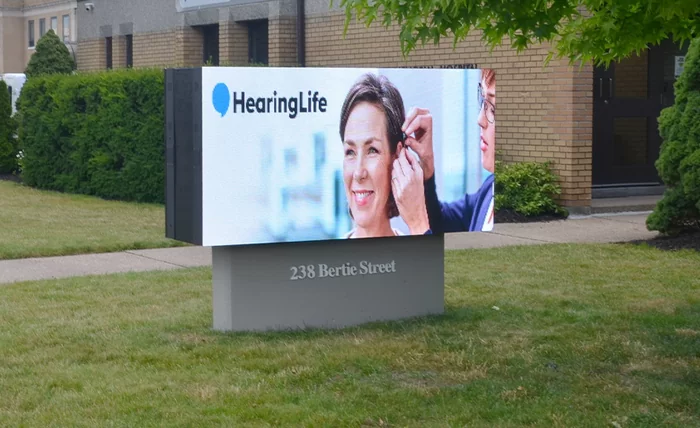
Palm Coast’s City Council heard a detailed proposal Tuesday on how the city could allow digital electronic signs — sometimes called electronic message centers — for the first time in its history. The proposal would allow digital displays only in non-residential zoning districts along specific roadways and includes restrictions on brightness, animation, and proximity to homes. No vote was taken; the proposal is expected to go to the Planning Board on April 15, 2026, and return to the City Council for a second workshop on May 12, 2026, before any formal action.
Senior Planner Estelle Lenz, who developed the proposal, said she researched regulations from Ormond Beach, Port Orange, Volusia County, Flagler County, and other Florida municipalities, and also worked with local sign contractors and the International Sign Association. Her proposal would allow digital displays on principal arterials — including US 1, Matanzas Woods Boulevard, Palm Coast Parkway, and State Road 100 — where up to 75 percent of a sign face could be digital. On minor arterials and major collectors, including Belter Parkway, Old Kings Road, and Florida Park Drive, the digital display would be capped at 50 percent of the sign face. Digital signs would be prohibited entirely on roadways identified as primarily residential, including Royal Palms Parkway, White View Parkway, and East Hampton Boulevard.
Key restrictions include: a minimum setback of 150 feet from residentially zoned property (though Vice Mayor Pontieri said she believes this is too close and pushed for 300 feet), a maximum pixel spacing of 10 millimeters, automatic brightness dimming based on ambient light, a hold time of at least eight seconds per message, and a transition limited to instantaneous changes or simple fades. Animation, full-motion video, flashing, and audio components would all be prohibited. Signs on vehicles or trailers would also be prohibited. The city’s economic development team has expressed interest in using digitally equipped monument signs at key Town Center entrances on State Road 100 and Belter Boulevard.
Council members were generally open to the concept but raised several concerns. Vice Mayor Pontieri worried about visual saturation — citing “Club Row” as an example of a corridor that could end up with six consecutive digital signs — and asked whether the code could cap the number of electronic signs allowed within a certain radius. Councilman Gambaro asked about enforceability and how city staff would measure brightness in the field. Staff confirmed that foot-candle meters capable of measuring ambient light are available for a few hundred dollars, and that code enforcement already has access to one. Several business groups have been pushing for digital sign options for years, including the VFW, which has sought a simple teletype-style sign for roughly two years. More information is available at www.palmcoastgov.com.
Palm Coast Refines Architectural Design Code: Air Conditioner Screening Rules, Roof Color Language, and New Industrial Standards Reviewed
The Palm Coast City Council concluded its Land Development Code workshop Tuesday with a review of Chapter 13 — Architectural Design Regulations — with discussion centering on air conditioner screening requirements, the use of vague language like “compatible” in design standards, and new rules for industrial buildings. No formal votes were taken; staff will incorporate council direction and return with a revised ordinance.
One of the more memorable moments of the long day came during a discussion of a requirement that mechanical equipment, including outdoor air conditioning units, be screened from view with landscaping or fencing. Landscape architect Richard Picatology and his colleague noted that a three-foot clearance around units was already being built into the proposal after an air conditioning technician came to a prior public meeting to complain that dense screening was making it impossible to service equipment. Mayor Norris shared that he had moved existing shrubs around his own AC unit when he moved to Palm Coast in 2006, not realizing it was required by code. “I just think it’s a weird ordinance. I’ve never lived in a house where you had to hide the AC,” he said. Staff committed to revisiting the screening requirements for waste disposal containers as well, and noted some areas where the setback rules for mechanical equipment conflict with existing drainage easements.
The council also debated the use of the word “compatible” throughout the architectural standards chapter, particularly in roof color requirements, noting it is highly subjective and could expose the city to code enforcement disputes. “What’s compatible to one person may not be compatible to another,” said the mayor. Staff was asked to work with the city attorney to develop clearer objective language. A similarly vague provision requiring “coastal building visual relief” — meant to allow partial views of the Intracoastal Waterway from public rights-of-way — was also flagged as unenforceable in its current form, as many existing homes along the waterway would not meet the standard. The council asked staff to explore whether the provision should be struck or limited to commercial properties only.
A provision that would have prohibited “neon lights” in shop windows was flagged as potentially banning standard open-sign displays used by small businesses. Council members agreed the intent was to prohibit distracting flashing or scrolling lights, not everyday window signs. Staff was directed to reword the section to carve out simple open or closed signs. On industrial architectural standards, staff explained that requiring industrial buildings to screen from neighboring industrial properties was intentional — a site visit to nearby industrial areas revealed that without screening, the appearance of broken equipment, piled fencing, and old machinery was significant. That screening requirement was retained.