

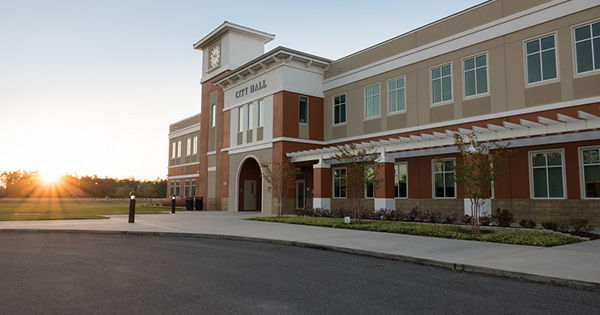
The Palm Coast City Council held its business meeting on Tuesday, February 17, 2026, at 9:00 a.m. in the John Netts Community Wing of City Hall. What began with a proclamation and a strategic plan update turned into a day-long session marked by intense public testimony, emotional pleas from residents, and a contentious 4-1 vote to approve additional housing in the East Hampton neighborhood. The council also approved an ordinance protecting the city’s utility system from sale, settled a long-running lawsuit over the Holland Park splash pad, and heard updates on everything from canal dredging to fraud and vape legislation.
Mayor Norris opened the meeting by asking for a moment of silence in memory of a resident named Eddie who was killed in an e-bike accident the previous week.
Phlebotomist Recognition Week
The meeting began with a proclamation declaring February 9 through 13, 2026, as Phlebotomist Recognition Week in the city of Palm Coast. A representative of a local training program spoke briefly, noting that the program had produced 47 certified phlebotomy technicians and 83 registered medical assistants. A student named Crystal, who was about to complete the program and had already been hired locally, was introduced to the council.
Strategic Action Plan Quarterly Update
Deputy City Manager Lauren Johnston presented the first-quarter update on the city’s 13 strategic action plan priorities. The update covered progress across several areas including infrastructure, stormwater, road safety, economic development, parks, and more.
On stormwater, Johnston reported that the city’s swale regrading pilot program had been successful and was being folded into standard operations. Vice Mayor Pontieri confirmed that the council had budgeted for the program to continue. On canal dredging, phase three funding was included in the current budget, and the city was pursuing state grant funding through a matching program that requires completed design and permitting before eligibility.
On road safety, a citywide road survey using a transmission index was underway, with results expected by May or June. The council discussed the Bellair Drive and Seminole Woods Parkway intersection along State Road 100, which continues to be a trouble spot. The city had signed an agreement with the county to receive impact fee funds from a nearby development for intersection improvements. Mayor Norris raised the issue of electric vehicle road taxes, noting that EV owners use roads but do not contribute through gas taxes.
Vice Mayor Pontieri advocated for continued focus on AI-driven traffic light technology, acknowledging that the software is not yet ready but urging the council to keep it as a priority. “I view this software as road infrastructure to make our roads work better,” she said.
On economic development, the council discussed the Promenade development in Town Center, which is expected to open this summer. Community Development Director John Zobler reported two active leases being processed, one with Fleet Feet, an experiential retail store, and one with an ice cream shop. A mini golf course had also received its construction permit. The council discussed Track 17, a city-owned parcel on US-1 that the city has been trying to develop for commercial use. Vice Mayor Pontieri expressed concern about the cost of purchasing entitlements for the property, suggesting the city explore public-private partnerships rather than taking on the financial risk alone. The city has an active request for proposals on the street for development of the site.
On parks, Vice Mayor Pontieri suggested the parks master plan priority needed to be more focused and tactical, noting specific community needs including a YMCA, pool issues, a skate park, and rectangular playing fields. The council discussed the potential for park user fees to help fund new facilities.
On the charter review committee, Johnston reported that the committee was formed in October 2025 and had held three public workshops. A special workshop with the council was being scheduled for the following week to review findings. A national community survey was also underway, with an open call for participation set for February 27. The SAP adoption hearing was scheduled for May 5.
Resident Darlene Shelley criticized the lack of full agenda packet availability for the public before meetings. Deputy City Manager Johnston confirmed that new agenda management software was being rolled out and that full packets would be available to the public starting in March. Mayor Norris stated that residents could request complete packets through the city clerk’s office in the interim.
Public Comment: Development, Water Quality, and Frustration
Public comment drew a range of impassioned speakers. Jeremy Davis, a Palm Coast resident, raised concerns about permit records for a property adjacent to his, stating that inspection notes tied to elevation and drainage had been deleted from the public record without explanation. “When inspection notes tied to elevation and drainage disappear without visible explanation, that raises a legitimate procedural concern,” he said.
Resident Connie Sparks reported yellow water and sand coming from her faucet and raised alarm about a bobcat in her backyard, asking when residential development near her property, which she was told was a preserve when she purchased her home, would stop.
Dennis McDonald urged the council to address what he described as 19,000 residential units under development order in Palm Coast that could be built. He recommended the land use administrator provide written reports to the city manager justifying approvals. “We have 19,000 residential units that can be built and pulled building permits right now, and we have no system to stop this runaway train,” he said.
Joy Cook, who identified herself as the woman who led the fight in Seminole Woods against apartments, delivered detailed remarks alleging retaliation against her family for speaking out against development. She claimed her husband was terminated from his job at the sheriff’s office without cause after six and a half years and alleged connections between developers, campaign donations, and political decisions in Flagler County.
Kirk Whittington, a retired engineer review officer from DeKalb County, Georgia, offered a different perspective, telling residents that growth management is an imperfect process and praising the council’s work. “The balance our country has is that developers have a right to develop their land to the highest best use,” he said. “The communities have a legal right to protect the health, safety, and welfare of their constituents.”
Vice Mayor Pontieri delivered an extended response to public concerns, saying the council had not approved a single new residential development that was not already entitled by previous councils. “This council has not approved a single new rooftop that was not previously approved,” she said. She pointed to the council’s record of turning down a fuel farm, a concrete batch plant, and 416 additional dwelling units in Seminole Woods. She also noted the council had raised impact fees to record levels and was now being sued by the homebuilders association as a result.
Councilman Miller explained that much of the city’s residential zoning dates back 60 years to the original planning by ITT, and that state legislation, particularly SB 180, has limited local governments’ ability to slow development.
East Hampton: A Contentious 4-1 Vote
The most debated item of the day was the second reading of the East Hampton Master Plan Development Amendment, which sought to increase the total dwelling units from the previously approved 58 to 71 by adding 13 homes. The property, located at the end of East Hampton Boulevard, was the subject of a 2004 lawsuit settled in 2012 that established the original 58-unit entitlement.
The matter was handled as a quasi-judicial proceeding, with all speakers sworn under oath. Community Development Director Michael Hansen walked the council through changes since the first reading, including increased minimum lot sizes from 5,500 to 6,000 square feet for interior lots achieved by extending lot depth from 110 to 120 feet. Perimeter lots on the north and west boundaries remained at 60 feet by 110 feet with 25-foot vegetated buffers. Hansen confirmed the revised lot sizes now comply with the city’s land development code.
The applicant introduced a new element since the first reading: a partnership with FBH Community, a nonprofit organization, to develop the property as attainable housing for essential workers including veterans, first responders, teachers, and healthcare workers. The applicant stated ICI Homes would donate the entire property to the nonprofit and make zero profit. FBH Community founder Fran Husseini told the council her organization, founded in 2007, builds homes at or below hard construction cost by working with trade partners who donate materials and labor. She said buyers must work in the local community, earn less than 120 percent of the area median income, and hold the property for at least 15 years. “We literally sell homes that we built at or below hard cost,” she said.
Dick Smith of ICI Homes confirmed on the record that the original 58-unit plan was not financially viable at market conditions, which was the same position the company took at the first reading. The nonprofit model, he explained, changes the cost structure enough to make 71 units workable.
Leanne, an Advent Health practice manager, provided personal testimony about how the FBH Community program helped her become a homeowner after years of being unable to qualify through traditional lenders. “If that’s what you call low-income housing, then I thank God for it,” she said.
Residents overwhelmingly opposed the additional 13 units. Multiple speakers from the East section raised concerns about traffic on the single-entry East Hampton Boulevard, stormwater management with the reduction from three retention ponds to one plus a pump station, the precedent of smaller lot sizes, and the last-minute nature of the nonprofit proposal. Sam Royer, an affordable housing advocate, urged the council to demand detailed documentation. “Get the fine details very clearly laid out because at the end of the day, there is a lot of bait and switch,” he said.
Carol Gunthorp told the council that residents of the East section were overwhelmingly opposed. “We look to you as our representatives. As our representatives, we expect that you protect our interests,” she said.
Mayor Norris asked the applicant why the nonprofit could not simply build on the 58 approved lots rather than requiring 71. The applicant explained that development costs spread across 58 lots created too large a gap for even a nonprofit to absorb, and the additional lots were needed to make the project financially viable.
Vice Mayor Pontieri delivered lengthy closing remarks in support of the project, citing data showing 42 percent of Palm Coast fire department employees live outside the county, that starting firefighter pay is roughly $50,000 while the median Florida home costs $370,000 to $413,000, and that entry-level public works employees start at $42,000. “I don’t want people that are going to be teaching my kid in school in a few years to be priced out of living in our community because we’re not considering them,” she said.
Pontieri also addressed campaign contributions head-on, acknowledging she had accepted $5,000 in donations from developers associated with ICI. “I’m going to give it back and I’ll still vote yes on this because I believe in it,” she said.
Mayor Norris asked Councilman Gambaro and Councilman Sullivan to withdraw their motion so the project could be tabled for further vetting. Both declined.
The council voted 4-1 to approve the East Hampton amendment, with Vice Mayor Pontieri, Councilman Gambaro, Councilman Miller, and Councilman Sullivan voting yes and Mayor Norris voting no. The approval was made contingent upon execution of the letter of intent with the nonprofit and restrictive deed covenants ensuring the property is used for attainable housing.
Minutes Approved
The council approved the minutes from the February 3, 2026, business meeting by unanimous voice vote with no objections or amendments.
Ordinance to Protect City-Owned Utilities from Sale
City Attorney Marcus Duffy presented a first-reading ordinance governing the sale of city-owned utilities. The ordinance, brought forward at the initiative of Vice Mayor Pontieri, would require a supermajority vote of four out of five council members and approval by voters in a citywide referendum before any city utility could be sold. It also mandates two public hearings, an independent valuation, a fiscal impact analysis, a service and regulatory analysis, and a competitive bid process. All debt associated with the utility would have to be fully satisfied before any sale.
Vice Mayor Pontieri said the ordinance was necessary to protect the city’s “most precious asset” from private acquisition, noting nationwide trends of equity funds purchasing municipal utilities. She requested removing a provision exempting short-term contracts of less than 10 years, calling it a potential loophole that could allow repetitive leases to circumvent the protections.
Councilman Sullivan expressed the view that the ordinance was somewhat symbolic since any future council could repeal it by majority vote, but said he would support it. City Attorney Duffy noted the ordinance adds procedural steps that would make a hasty sale more difficult.
Resident Darlene Shelley argued the city does not know how to run its water utility and questioned where the $350 million in utility bond money was going. Resident Tony Amaral asked whether the ordinance would prevent the utility from being transferred to a governmental organization like FGUA if circumstances warranted it.
The ordinance passed on first reading 5-0, with all council members voting yes.
Splash Pad Settlement Approved
The council approved a resolution settling the Holland Park splash pad lawsuit, case number 2022-CA-00773. The settlement recovered $2.375 million of the $2.4 million in original construction costs that were determined to be assignable after both the design and construction of the splash pad were found to be faulty.
Councilman Miller explained the council had pushed for additional recovery beyond earlier offers and succeeded in getting the more liable party to increase its payment. He noted that continuing to litigate for the remaining roughly $25,000 risked costing the city more in legal fees and could expose it to paying opposing counsel fees if ruled against. Councilman Sullivan described it as “the point of diminishing returns.”
Mayor Norris praised the collaborative effort, noting the splash pad is now operational and well-used by families. The resolution passed 5-0.
Consent Agenda
The consent agenda included multiple items covering utility repairs, well rehabilitation, generator maintenance, and a federal BUILD Grant application for Old Kings Road. Resident Tony Amaral questioned the rate of well capacity loss, noting some wells had lost 60 to 80 percent of their flow in six to eight years. Utility Director Brian Rose explained that well rehabilitation is standard practice and that the city was developing a more formalized program. He noted Palm Coast’s wells produce lower volumes than deeper aquifer wells found elsewhere in Florida.
Mayor Norris clarified that the data center connectivity item on the consent agenda involved linking the city’s server room at Water Treatment Plant 3 to a new backup server room at City Hall for redundancy and had nothing to do with the DC Blocks data center project. The consent agenda passed 5-0.
Tallahassee Legislative Trip
Multiple council members reported on a recent trip to Tallahassee to advocate for city priorities. Vice Mayor Pontieri said she met with the Department of Environmental Protection about water quality grants and that the secretary offered to meet again after budgets are finalized to identify specific grant opportunities for water projects. She also reported meeting with the Department of Business and Professional Regulation and the Department of Agriculture about vape regulation, and said she is working with Representative Greco to draft legislation restricting smoke shop locations near schools, daycares, and churches.
Councilman Miller reported that three Palm Coast projects appeared in the initial House budget: the Burroughs Drive stormwater project, the Woodlands stormwater capacity project, and the animal shelter. He cautioned that the process is still early and final budgets are not set.
Councilman Gambaro praised the united front the council presented in Tallahassee. Vice Mayor Pontieri noted the council had submitted information to the state’s DOGE efficiency review and was awaiting specific feedback. Several members noted that federal COVID relief money has dried up and will not be returning.
Other Business and Closing Comments
Councilman Miller provided an update on efforts to get traffic signals installed at the Matanzas interchange on Interstate 95, saying the process requires federal studies and inclusion in the state’s five-year work program. He said he does not expect work to begin this year but is advocating at multiple levels of government.
The city manager reported that staff would follow up on issues raised by citizens, that the city had submitted its DOGE financial information, and that the emergency and sole-source procurement report for January 2026 was included in the council’s packet.
Mayor Norris reminded the public that March 1 is the deadline for homestead exemption applications. He also announced the 2026 Mayor Mike STEM Scholarship, which will award one $2,500 scholarship each to a senior at FPC and Matanzas high schools, plus an additional $1,250 scholarship.
The meeting adjourned after a motion was made and seconded.